Queer ecological subversion in Shakespeare’s Midsummer Night’s Dream
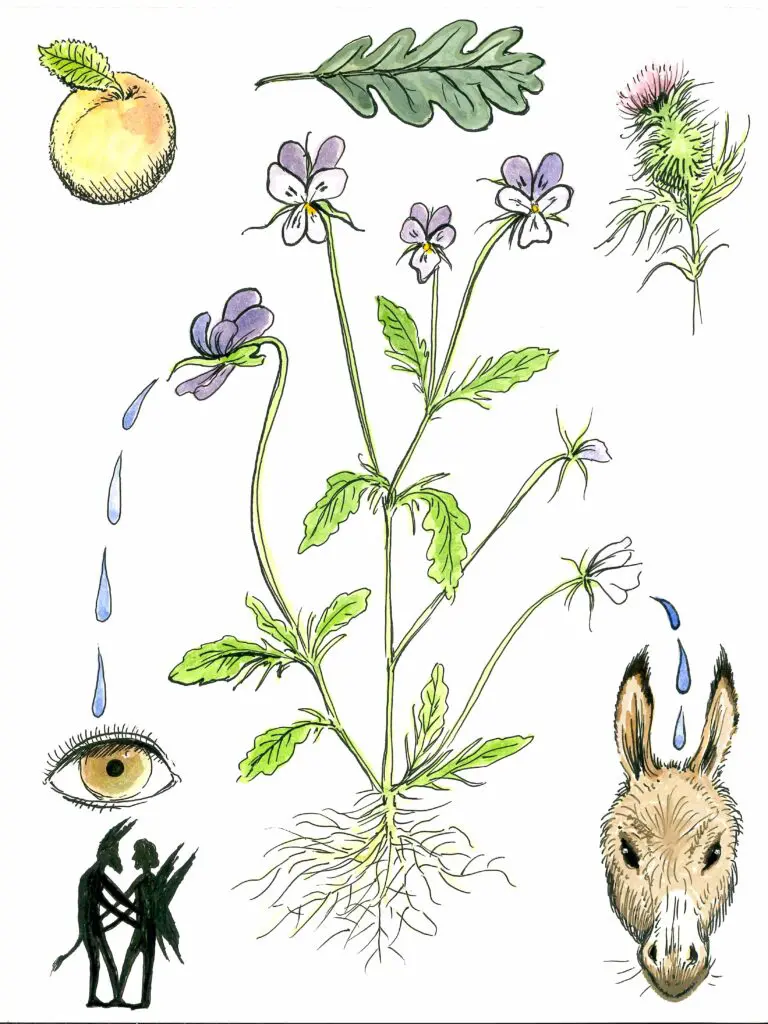
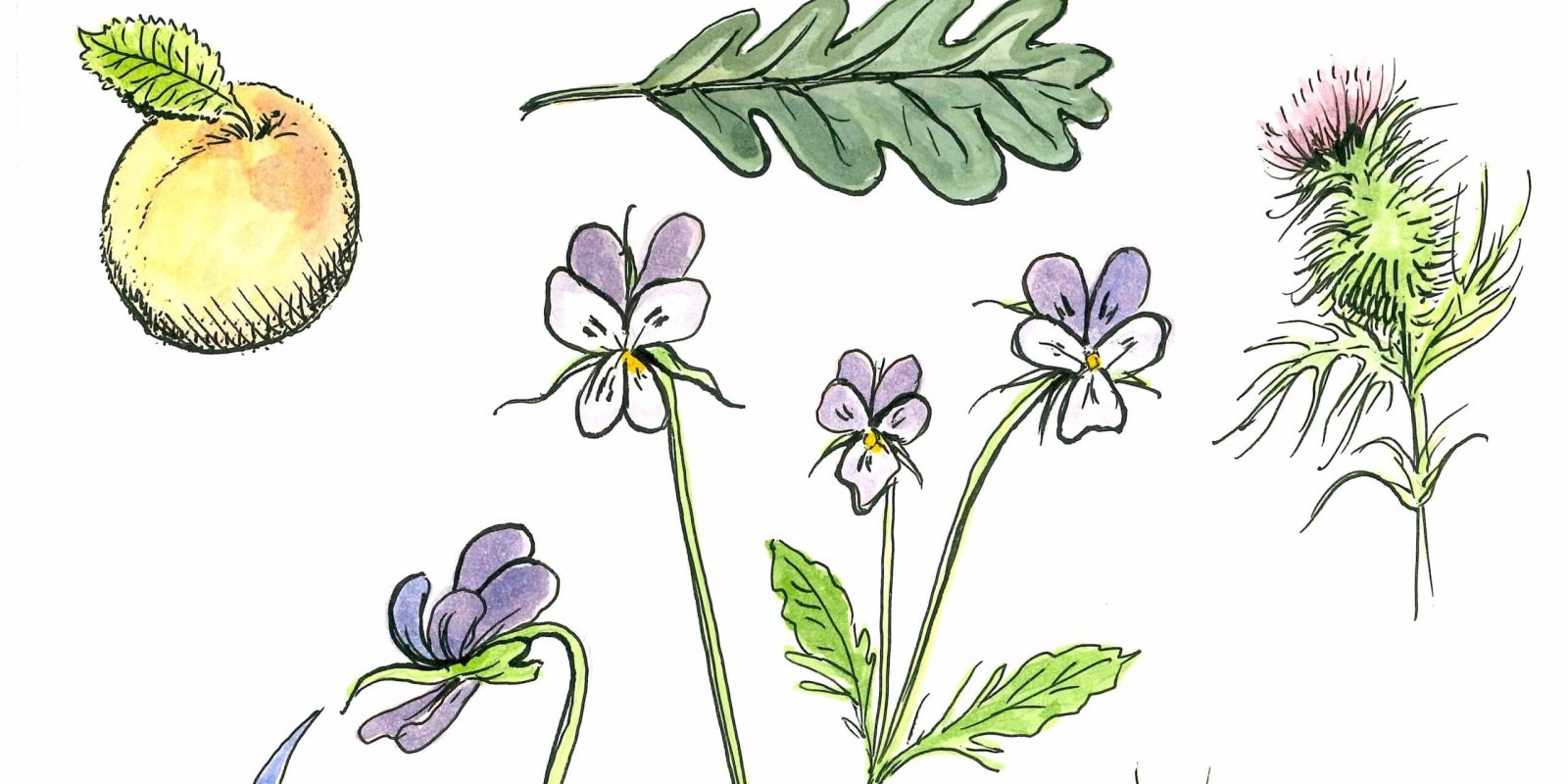
In A Midsummer Night’s Dream, the natural world queers the flimsy rules of human behavior. The woods outside of the palace offer a fecund wilderness for subversion; the laws of Athens dissolve in the shadows of the hawthorn and elm. The script is rich with botanical language representing a very British flora: acorn, “apricock” (apricot), bean, broom, cherry, cowslip, crab apple, dewberry, fig, garlic, grape, hay, hemp, honeysuckle, ivy, knotgrass, leek, lily, mulberry, muskrose, oak, oat, onion, oxlip, pansy, pea, primrose, provender, sweet-brier, thistle, thyme, wormwood. One can imagine the landscapes and ecologies that Shakespeare pulled inspiration from: the farmlands and sheep fields around Stratford-upon-Avon, the urban weeds growing along the Thames, and the Forest of Arden.
This is a play of contradictions; on a superficial read, the plot follows several aristocratic couples away from Athens and into the woods, where amusing shenanigans ensue amidst the population of fairies that occupy the wilderness. On a deeper level, the play is less about the honest romantic love between these heteronormative lovebirds from the city, and more about sexual desire, trickery, confusion, and possession. Many of the characters find themselves in unexpected erotic entanglements. Some of the strongest bonds are between characters of the same gender, charged with homoerotic undertones, although this is no surprise—nearly all of the female parts in Elizabethan theater were played by male actors, and beyond this practical gender swapping, many of Shakespeare’s scripts feature gender play and queer sexual innuendos. To name but a few: in Twelfth Night, the central character Viola dresses as a man; in The Tempest, Ariel is gender ambiguous; in As You Like It, Rosalind disguises herself as a boy named Ganymede. Many authors and scholars have suggested that Shakespeare himself may have engaged in amorous poetic exchanges (and more) with men—Oscar Wilde suggested that Shakespeare’s sonnets were penned to a young man, a “fair youth” in line with the dedication of the sonnets to “Mr. W.H.” Sonnet 20 is a particularly playful ode to this gender fluid fair youth,
A woman’s face with nature’s own hand painted
Hast thou, the master-mistress of my passion;
A woman’s gentle heart, but not acquainted
With shifting change as is false women’s fashion
Not surprisingly, the predominant chorus of heteronormative, canonical literary scholars in academia have resisted Wilde’s interpretation in favor of more palatable, practical explanations; that Mr W. H. was a benefactor, or a friend of the publisher. Elaine Scarry, author and professor at Harvard, revived Wilde’s delightful theories in her book, Naming Thy Name: Cross Talk in Shakespeare’s Sonnets, with the suggestion that Shakespeare’s secret lover was Henry Constable, a poet contemporary of the Bard. Apparently, both Shakespeare and Constable wrote mirrored sonnets about a thwarted love—in both sonnets, each poet names the violet as the flower thief whose hue is purple from blood stolen from their lovers’ veins. Floral goth! Shakespeare’s version even offers the phrase “purple pride,” and although I’m bringing all of my own modern connotations to these words, I can’t not include them. In A Midsummer Night’s Dream, Nature herself is imbued with sensuality. No truth holds permanent power—every rule and law can be manipulated by magic, desire, and the nectar of a particular flower.
In the first act, Lysander convinces Hermia to run away to his dowager aunt’s house, a “remote seven leagues,” where they can be safe from the “sharp Athenian law” (1.1.159 and 162). They plan to meet first in the woods—a liminal space between the strict social conventions of Athens and the promise of freedom in the childless aunt’s domain. When Helena joins the conversation, Hermia lets her in on the secret plan, describing this liminal, natural space as “the wood, where often you and I upon faint primrose-beds were wont to lie” (1.1.215), a description which certainly paints the relationship between these “playfellows” with a nostalgic, Sapphic-hued brush. There, in the woods, they hope to “turn away our eye to seek new friends and strange companions” (1.1.219). In other words, they imagine that once they leave the walls of Athens, abandoning the patriarchal tradition of arranged marriage, they will form entirely new types of relationships. I find the phrase “strange companions” so compelling—here, Hermia doesn’t merely suggest they she and Lysander will be free to marry one another, but that they will both form new and unusual connections—her visions of the wild territory beyond Athens seems to have expanded to encompass her unspoken fantasies.
In the act that follows, we witness the jovial rendezvous of the “rude mechanicals,” local tradesmen, who coincidentally plan to meet a mile outside of town in the woods, by moonlight, in order to rehearse their play, “The most lamentable comedy and most cruel death of Pyramus and Thisbe.” These players subvert the serious marriage plots of the aristocratic couples in the preceding scene through the contradictory nature of their play’s title, as well as the gender-fuckery of Flute, the Bellows-mender, playing Thisbe, and Bottom, the Weaver, playing Pyramus, although Bottom generously offers to also play Thisbe with his “monstrous little voice” (1.2.45)—sounds a lot like drag, to me.
To all of these characters, no matter their social status or gender, the woods seem to represent a safe haven from judgment; a happy alternative to heteronormative restrictions; a location for secret romantic trysts as well as theatrical performance; a magical space to explore and pursue one’s conscious and subconscious desires. The queer nightclub of the forest. Who else could better guide this land of subversion than Robin Goodfellow, the trickster who also answers to the name Puck? A fairy introduces Puck as a “shrewd and knavish sprite” and a “Hobgoblin,” and Puck responds that yes, “I am that merry wanderer of the night” (2.1.34-43), reinforcing several distinctions here between the daytime rules of Athens and the fluid behaviors of the woods at night. Many such dualities flip-flop throughout this play: comedy/tragedy, waking/dreaming, love/hate, beautiful/ugly, male/female. As audience members, we are challenged to determine who is dreaming and when, or if we have dreamt up the entire performance. The woods, however, certainly hold more fluid possibilities for manifesting the desires of the characters than do the halls of the palace or the streets of Athens. Nature brings out the wilderness of everyone’s personality; in a Freudian reading, everyone who enters the woods is able to express their id. In a more ancient, folkloric reading, the passage from Athens into the woods evokes the journey into a fairy ring—all mortals who pass into a circle of mushrooms are forced to dance until they drop, or until they descend into madness.
Yet it is not a ring of mushrooms that borders the portal into folly and magic, but rather a flower:
Oberon asks Puck to retrieve a “little western flower, before milk-white, now purple with love’s wound, and maidens call it ‘love-in-idleness’” (2.1.168). Although we can’t be certain what flower Shakespeare imagined when he penned this line, this common name is generally accepted to be Viola tricolor, or wild violet, in the same family as the pansy. This flower family could not be more saturated with queer symbology—from Sappho’s violets to the more modern insult of ‘pansy,’ which in certain contemporary queer circles has been reclaimed as a badge of honor.
Even the origin of the flower’s properties is charged with erotic language: once white, it now blooms purple after having been pierced by Cupid’s “love-shaft” (2:1:158). The flower’s juice, when sprinkled on the eyelids of a sleeping human, has the ability to transform the nature of desire, to expand the categories, genders, and even species of the object of love. The man or woman will “madly dote upon the next live creature that it sees” which seems to offer an even more broad definition of pansexual: love for all, beyond gender, post-human or more-than-human sexuality. This flower’s charm extends, of course, to donkeys, and one ass in particular: Bottom, who has been translated by Puck from a weaver into a furred beast.
The boundaries between waking, dreaming, truth and delusion become blurred in each scene, particularly away from the city and in nature’s bosom. The woods seem to enhance the dreams of all characters, even those not touched by the juice of the magical violet. Hermia wakes in horror from a nightmare in which a serpent crawled on her breast and attempted to eat her heart (2:2:155), only to realize that a different nightmare has come true: her beloved Lysander, under the spell of the violet, now despises her and now competes with Demetrius for Helena’s love.
The woods also become a makeshift theater, in the third act, the rude mechanicals meet in a clearing to rehearse, and Quince describes with satisfaction, “This green plot shall be our stage, this hawthorn-brake our tiring-house” (3:1:5). Titania’s bower could also be viewed as a sort of stage, on which a comedy crafted by Oberon plays out; she falls head-over-heels for Bottom the ass. Bottom, once transformed into an ass, speaks more wisdom than when he was but a man, “to say the truth, reason and love keep little company together nowadays” (3:1:127). In this way, he becomes the lucky, wise fool who momentarily benefits from Puck’s tricks—fairies scratch his furry nose and ears and bring him oats to munch.
Sadly, to me at least, all of these delightfully queer dalliances return to a heteronormative status quo towards the end of the play. Puck reverses the flower’s spell so that “Jack shall have Jill”—Lysander shall have Hermia, and Demetrius shall have Helena, and “The man shall have his mare again, and all shall be well” (4:1:463). Not only do the gendered couples revert to the binary, but the women become possessions, pets, mares to their men. What’s even more disappointing is that Oberon refers to all the merry trickery the “night’s accidents” which he compares to a “fierce vexation of a dream.”
Fortunately, the fairies and their secret nighttime spells add a bit of flair and confusion to the marital pageantry—after the royal feast and the performance of the rude mechanicals in their clunky rendition of Pyramus and Thisbe, the hetero-couples retire to their wedding beds, and the fairies roam the halls, blessing each bed with “field-dew” (5:1:401). Puck takes the final word, suggesting to the members of the audience that if they find the performance displeasing, then they may have been dreaming all along, “you have but slumbered here while these visions did appear” (5:1:413). This little speech complicates all of the preceding scenes—if the audience has been asleep, then which of the characters have been awake? Who remains under the spell of the wild violet? What is the true nature of each character’s lust and romantic feelings? Demetrius, after all, was never given the herbal antidote to his ‘love-in-idleness’ potion, and his newfound love for Helena is the product of the flower’s juice. Many of the characters spend half of the play asleep and dreaming, or under a spell—Titania, Bottom, Lysander, Demetrius, perhaps even Hippolyta, queen of the mythical Amazons, who was likely abducted from her home, ‘wooed’ by Theseus’s sword, might be under a spell. Why else would she so passively accept her capture? The premise of the violet’s potion, which shifts the very nature of a human’s desire, calls into question the sanctity of the three heteronormative unions which take place in the final acts of the play. Demetrius’s love for Helena is not his own, it is the flower’s spell. Titania seemed much more passionate about her relationship with Bottom, even if it was within a dream or while flower-drugged. Her behavior towards Oberon after she wakes from this dream seems restrained, forced, as though she were simply playing the part of a patriarchal marriage; she must perform her role as queen to her king.
One character appears to have the power to traverse borders and binaries in this play: Robin Goodfellow, Puck—like a magical medieval botanist he controls the delivery of herbal potions; he moves between the realms of nighttime dreams and daytime lucidity; he travels between the wild woods and the palace walls, he remains free of the constraints of marriage. This merry trickster, wise fool, nature’s sprite, shadow shapeshifter, turns out to hold the most power.
In the end, the wilderness of A Midsummer Night’s Dream stands not just as a backdrop for whimsical misadventures, but as a potent site for queering the play’s romantic conclusions. The woods, with their enchanting chaos and fluidity, offer a sanctuary where traditional binaries dissolve, where characters explore identities and relationships that defy societal norms—exemplified in the playful interactions of the fairies and the transformative power of the love-in-idleness flower. Even as the final acts seem to tether the characters back to heteronormative structures, the fairies bring the essence of the forest to the palace at night to the marital bedrooms, inviting us to question the legitimacy of those unions. Puck, the trickster, becomes a symbol of this irrepressible wilderness—his ability to traverse boundaries and manipulate desires highlights the potential for a world where love is unconfined by convention. The play, then, becomes a celebration of nature’s role as a catalyst for transformation. Unless, that is, you are actually asleep and dreaming throughout the play, under the spell of a “weak and idle theme, no more yielding but a dream,” or perhaps Puck dripped violets in your eyes, and when you wake, you will fall in love with the next breathing being that crosses your vision. Oh, the elusive truth—the only solution is to release your hold on reality and enjoy the uncanny romp.