
A Fungal Queendom with Sexy Twins
People who study fungi deeply form a category of their own at times, not too dissimilar to a cult. They often wear fungi-related clothes (think of Paul Stamets’s hat made of amadou, also known as tinder fungus, or Fomes fomentarius), have fungi tattoos, send fungi GIFs to each other (there are many), and make fungi-word jokes. I know this because the more I’ve learned about fungi, the more I’ve become like this. One of my favorite jokes that plays with fungal words came from Brazilian mycologist Maria Alice Neves, who likes to say ‘Micorriza se estiver errado’ instead of ‘Me corrija se estiver errado’—a tad untranslatable from Portuguese, but basically slipping in a mycorrhizal network when saying ‘correct me if I’m wrong’. Neves admits that she can’t help herself and always plays with language, especially in the mycology classes she teaches. ‘My students sometimes even feel embarrassed with all the silly jokes and don’t laugh but they can’t stop me from making them!’
Another thing that many mycologists have in common with each other is how they drop long and complicated Latin names of fungi with the ease of talking about a friend in common. Like everyone has knowledge. To not interrupt an interview through my unknowingness and asking about which mushroom they were referring to exactly, I would secretly, fanatically, make incomprehensible notes. This classic case of pretending to understand left me having to Google the guessed and cryptic names I had scribbled down. It helped if I added ‘+mushroom’. Nine out of ten times I got it right. Yet dear Google also brought me somewhere completely different, to a world that I had not (yet) associated with mushrooms: porn. Warmed by the blush that always catches my cheeks when I least want it, I told myself this was also ‘research’ and decided to explore more. A world of ‘mushroom cocks’ opened up. A big throbbing fungus as a sexual organ appeared to be a rather desirable thing to possess in the porn community, symbolizing masculinity and pride. I opened another tab (also so that I could quickly click away if needed) and searched for the common stinkhorn mushroom, in Latin appropriately called the Phallus impudicus (impudicus being Latin for shameless). And, yes, the resemblances were astounding! I never imagined many points of connection between YouPorn and the Woodland Trust, but the mushroom cocks and the stinkhorns were practically sexy twins. I began to wonder about mushrooms and masculinity. I was aware that there is a movement of people who are pushing to call the world of fungi a queendom, rather than a kingdom. The first person to tell me about this was Giuliana Furci, the founder of the Fungi Foundation. In our interview, she referred to fungi queendom even though she was quick to add that the term was scientifically incorrect. This simple and playful suggestion of a name-change, however, actually opened up a lot of interesting questions. I continued to look and came across a mycologist whose Instagram handle was @queendomfungi. Clearly, this was the woman I had to speak to. A few weeks later, when we manage to plan a call, Patricia Kaishian tells me that the term queendom wasn’t something that she felt had to be adopted scientifically, but that she invoked as a way of making people stop and reflect on terminologies that are ‘pervasive and unquestioned’. The aim was to give people a moment to reflect on the histories that are the foundation of the sciences we are operating (with)in or are in relation to. More as a moment of pause. I ask her about other terminology we need to review and she stays within the domain of gender.
The first thing that comes to mind is notions of sex; discussions of male and female and reproductive structures. In science, outside of human discussions, organisms are not gendered. Only humans are gendered because it’s a social construct.
Anarchist Mushrooms
Male and female are still loaded terms. ‘You wouldn’t see that tree as a man, but you could say that that tree is a male because it has particular structures,’ Patricia posits. It’s true that there is a lot of meaning bound up in male and female that also goes un-interrogated. Kaishian:
With fungi, because they are so infrequently binary, you can have thousands of mating types within a species. Male or female, there are potentially tens of thousands of different combinations of genes that can give different types of arrangements. But it’s really common in animal biology and animal behavior to just have the male and the female. I won’t say that I think these terms should be removed, but it’s definitely a great place for conversation, with your students, colleagues, and other people.
The numbers she shares with me are quite overwhelming, those tens of thousands of different combinations for fungal sex. It makes our human categories of LGBTQIA+ suddenly sound ever so limiting in terms of sexual preferences. When I speak with mycologist Juli Simon, who works in the Brazilian Amazon, and who identifies as non-binary, it becomes more technical:
If you have two different mycelia trying to mix there is a system of compatibility that is not about the gender of one or another; there can be over twenty thousand compatibilities. It’s got nothing to do with male or female.
Basically, Juli is saying that the mycelium teaches us that the mushroom is not binary as the mycelium can go anywhere, hook up with anyone. There is a strikingly clear lesson here that we can use as a reference, and as direct inspiration, to free our human and rather boxed-up and limited understanding of gender and sexuality. Juli continues: ‘Knowing that they don’t have a mating type that is binary really made me impersonate and connect with mushrooms. They are anarchists!’ After having conducted a dozen interviews or so, it suddenly dawned on me that not just Juli, but quite a few of the other interviewees didn’t feel aligned with hetero-normativity. Was this a coincidence or not, I wondered…?
Patricia Kaishian has a theory about this, based on having read a study that the Mycological Society in America had conducted. The MSA is one of the biggest and oldest (founded in 1932) mycological societies in the world. The Mycological Society of the United States also has a committee focused on diversity, and has initiated a survey identifying the percentage of LGBTQIA+ mycologists within their society, which consists of several hundred people. Of all the respondents, twelve percent identified as LGBTQIA+. Patricia Kaishian notes that it was maybe not a ‘perfect study’ but that, nevertheless, it’s interesting information that could, and should, be explored more given that this percentage is a lot higher than in a regular science lab.
There is definitely research potential there, confirmed by Kaishian’s funny anecdotes about being in a room full of mycologists and realizing they were all queer. It led her to write the compelling essay ‘Mycology as a Queer Discipline’, in which she argues that mycology relies upon queer methodologies because of the ‘non-binary, cryptic, and subversive biological nature of fungi.’ Fungi disrupt the binary conception of plants versus animals because they possess a mixture of qualities common to both groups. In addition, they demonstrate there is much more possibility beyond the two-sex mating system. Kaishian gives the example of the Schizophyllum commune, a mushroom that has as many as twenty-three-thousand mating types.
When two compatible fungi meet, their mycelia will fuse into one body, sexually recombine, then remain somatically as one as they continue to live, grow, and explore in their environment.
Patricia also has some other interesting facts about the Schizophyllum commune, such as how it can strangely infect humans who are severely immunocompromised.
People can become very ill as the fungus can establish itself in the human body, which is also very interesting and sort of strange. We don’t know much about it; the fact that it can go from being a wood decaying fungus to living inside a human body is not a very well understood phenomenon.
More Liquid and Less Square
Fungi can reproduce both sexually and asexually. Though the asexual reproduction is a slow process, there are many different fungal strategies of propagation. Asexual spores are produced by cell division and the most common type of asexual spores are called conidia. Alternaria alternata, which is the common black fungus that causes black spots on fruit and vegetables and can cause allergies in humans, is an example of a fungus with hypha that bears conidia. Mycologist Maria Alice Neves shares with me that ever since she started teaching about fungi in schools and universities, she has been advocating that we should all be more like fungi. When I ask her what the most important lessons from fungi are for her, she also agrees that this is probably regarding sex or gender, or as Neves calls it ‘to not see as square as we always tend to see.’ She too reiterates the incredible number of different combinations that we can consider sexes or genders in terms of pairings for fungi.
If we think of that as a way in which nature is stopping interbreeding and making fungi prosper, it is such a good example of how we could see ourselves. Being less black and white about our sex, as it is much more liquid and really not so square. I think that’s a way fungi teach us to become less prejudicial and more inclusive.
Epupillan
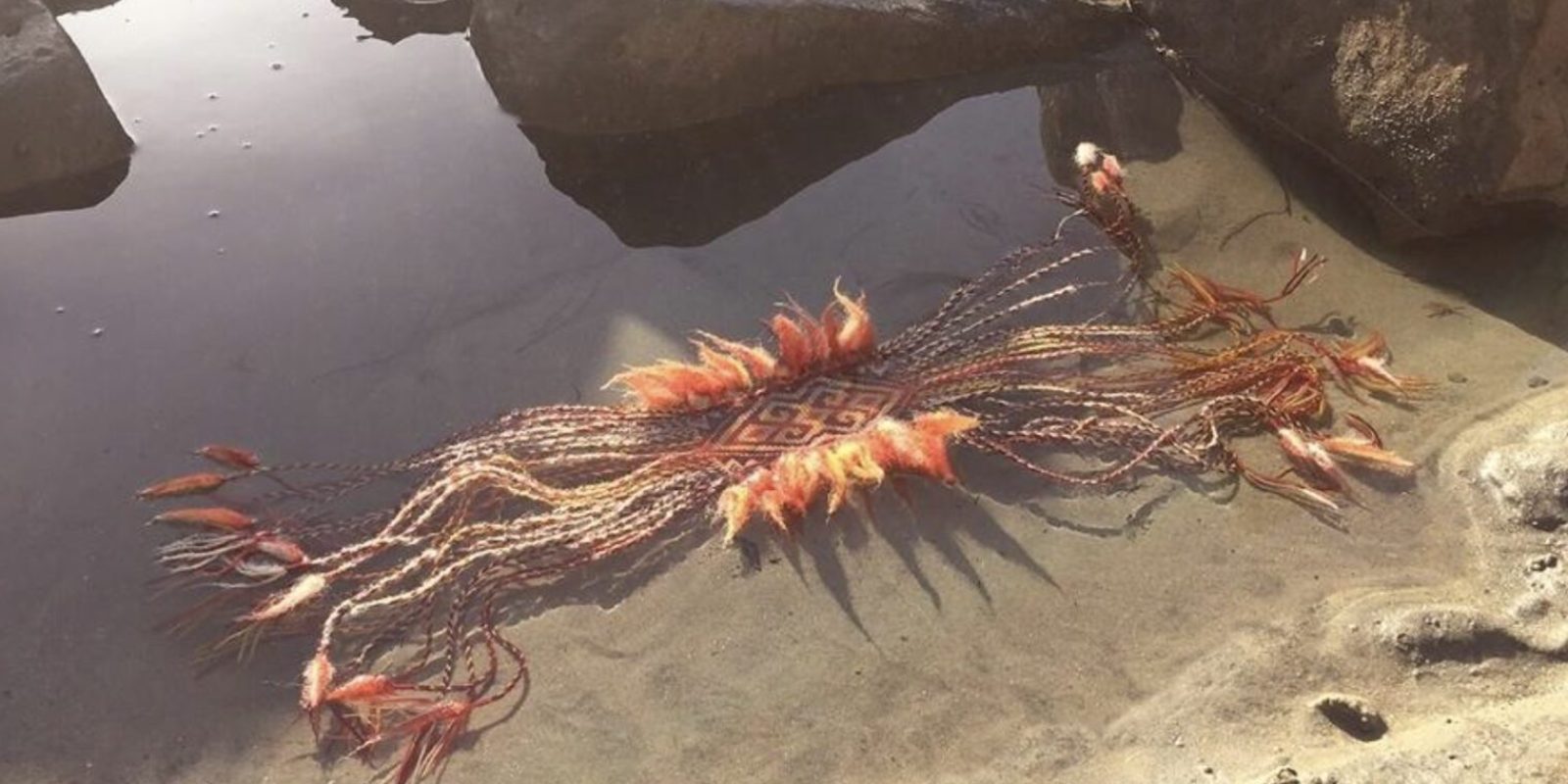
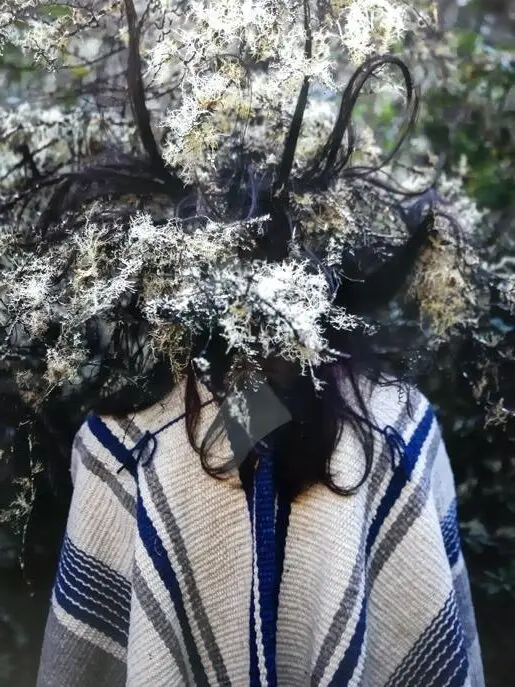
Being non-binary is nothing new. In fact, in many indigenous cultures the people of ‘two spirits’ means that they are doubly blessed, the most spiritually gifted and, therefore, highly respected. They often have the role of the shaman, a teacher, or spiritual or religious leader, or other special duties within the community. It was the colonists—the Spanish in Latin America and the English in North America, and later the conservative Christian Church—that introduced the homophobia, discrimination, misogyny, and stigmatization of the so-called fluid third gender. Non-binary people were condemned by the Church as sinners and sodomites. In Mapuche cosmology, people who did not inhabit one gender used to have a very special status, and the ability to connect with both male and female forces. They were called epupillan (also literally meaning a person with two spirits), referring to a type of spirit that is a higher entity than a human, a spirit that is infinite. I learned that epupillan can not only move between the feminine and the masculine, but also between animate and inanimate life connected to the earth (the Mapu in Mapudungun). That means that they can help people connect with biodiversity (itrofil mongen in Mapudungun). The work of artist Seba Calfuqueo, non-binary and of Mapuche origin, is auto-biographical, poetic, and performative, telling stories of what it was like to grow up being bullied over having a Mapuche background and for being non-binary. The work I went to see was part of the exhibition ‘Árboles torcidos’ at the Art Gallery of the Universidad Católica in Temuco and illustrates the strong environmental dimension of issues around gender and culture. In a series of photographs, Seba’s beautiful long hair is braided with the lichens of the forest. In a video work they bathe in the river and leave a long trace of deep blue textile. In my attempt to learn more about epupillan, however, I had little success. This part of colonial history is sparsely documented and largely erased. Besides more general information about the two-spirited, a lot of archival information and other historical documents about epupillan have been destroyed. The colonists left a hole in the documented history. A key source of stories and knowledge is Comunidade Catrilon+Carrión, a queer/trans/nonbinary Indigenous epupillan (two-spirit) community comprised of five artists. They dedicate their research to the tradition of epupillan beings in Mapuche society. Their artistic research ‘seeks to form social and artistic relationships that transcend a hetero-patriarchal regime.’ As a collective, they protect knowledge about epupillan, which for them is a way to keep the ancestors’ memory alive. The term is not solely descriptive of people who identify as non-binary, they explain in a text written for Terremoto magazine, but for people who do not identify with heteronormativity, who position themselves as free beings, ‘sexual dissidents’, and those who refuse the violent repression of coloniality. In the article, they describe how ‘it’s not just a category of gender and/or sexual preference’, but much more than that. It’s entangled with anti-colonial and anti-racist values. Antonio Catrileo Araya, Constanza Catrileo Araya, Malku Catrileo Araya, Alejandra Carrión Lira, and Manuel Carrión Lira, the members of the collective, are actively retrieving and documenting stories and memories of epupillan using the language of the arts, and particularly through Mapuche weaving, a source of ancestral knowledge.
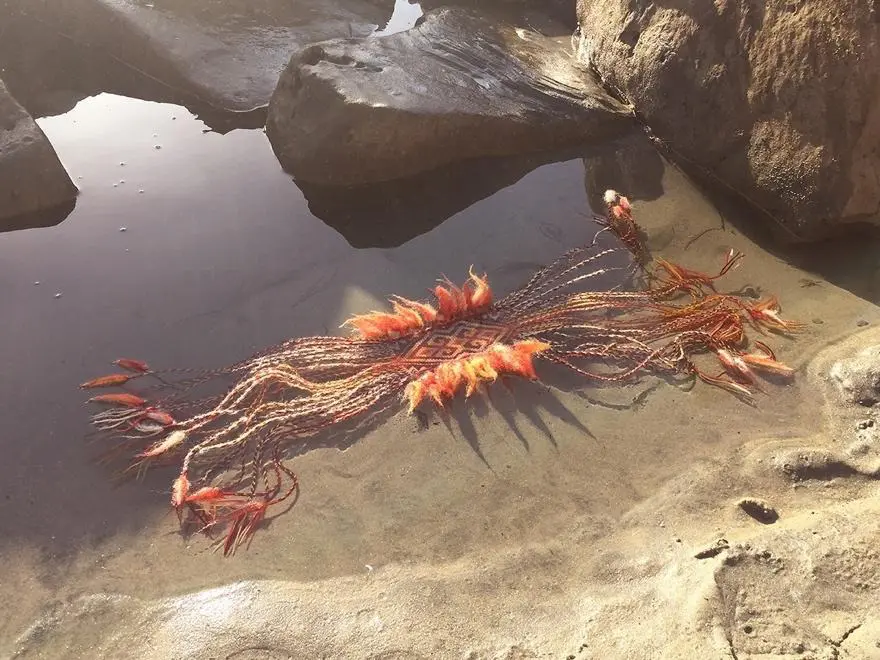
The work is a recording of a ceremony/performative work in which two textiles are offered to the great body of water of the Pacific Ocean that connects the members of the collective living in Pikunmapu /Qullasuyu (Valparaíso, Chile), with the other members that currently live in Kumeyaay land (in San Diego, California).
Speaking with Mapuche mycologist Fer Walüng about non-binarity, she of course mentions the diversity of fungal genders, but also brings up the Pehuén, the Araucaria tree that is central to Mapuche cosmology. She explains to me how, depending on the necessity or the place, the Araucaria is able to change sex. In order to reproduce, the trees first produce a lot of piñones, the seeds, for two or three years. After a year or two, the process of self-fertilization takes place, in which time the tree does not yield piñones. Fer also explains how the mycelium can have a remarkable diversity of forms, from polymorphous to homogenous, and how it is constantly changing. Fer:
If you observe the sexuality of plants, animals, mushrooms, insects, you will see that gender is imposed by us, by the system, by the ideology of capitalism. This deprives us of liberties. As with our own preferences; as soon as you are born things are already fixed; you are given a name; your gender is determined and that includes a color such as pink or blue, and often even the role you are expected to play—as a man or a woman—is fixed.
Fer thinks that Chile, her home country, is particularly backwards when it comes to the inclusion of different gender identities, the result of a lack of education about it, and generally conservative thinking. ‘There is no acceptance of the idea that we are non-binary beings and that social sexual gender is imposed by ideology.’ She explains that often men are far removed from their female consciousness, from their feelings, because they are taught from birth to conform to certain patterns that constrain them emotionally and spiritually. Fer:
And then feminism comes in and demands respect for many important, valuable things that are essential in life. But they hit a wall because many men have never learned to express their emotions. As a result, women get blamed for the problems.
Fear of the Unboxed
The point of many languages and sciences is generally to seek clarity and functional objectivity in binaries and boxes. Yet objectivity is more often than not a political fiction, an impossibility, especially when it comes to gender and queerness. Though the idea of categorization is useful, it doesn’t always work—and not in science, either. In her mycology classes, mycologist Maria Alice Neves explains that her students are often confused and want to put the fungi they are studying into boxes of categorization. Neves:
We can try to put tags on them, but it can be a mycorrhizal fungus that is connected to a root and that can also be predating and killing collembola (a soil-dwelling arthropod; a small invertebrate animal with an external skeleton that lives in the soil) to give animal nitrogen to that plant. How do we define that organism?
Fungi can have contradicting behaviors and there are many exceptions to every rule. Does it make sense to obsess over taxonomies, or should we be focusing on the relationships between species instead?
To not be so easily boxed and categorized is a quality that seems to be hard to accept for some people. This fear of the unboxed could be the root of both myco-phobia and queer-phobia. People have a hard time dealing with fluidity and things that don’t fit in their boxes. In ‘Mycology as a Queer Discipline’, authors Patricia Kaishian and Hasmik Djoulakian trace this binary thinking to Christianity. As explained in the text, scientists were strongly influenced and sometimes even financially supported by the Church. Even philosophers like Descartes were loyal to the Church in their ‘supposedly objective pursuits of knowledge’. The influence of the Church was all-encompassing, even projecting Christian values concerning domestic and marital structures on to agriculture. Kaishian and Djoulakian refer to this as ‘agro-heterosexuality’. In the book New Perspectives on Environmental Justice, edited by Rachel Stein, what this term refers to exactly is described more extensively. In a nutshell, the seeds of the crops were considered to be male and the land that had to be fertilized was supposedly female. Anything outside of this Christian binary wasn’t natural. Any contemporary scientist, however, can confirm that this is far from the reality.
‘Nothing is more queer than nature’ is one of the great pearls of wisdom of Colombian scientist Brigitte Baptist. In 2018, I attended a talk by this transgender scientist who is an advocate of both gender and biodiversity. The talk took place in Amsterdam, inside the framework of the ‘Louder than Words: Global Leaders on the Frontline of Culture’ seminar by the Prince Claus Fund. Baptiste arrived on stage in a spectacular dress with big butterflies and turquoise-dyed hair, making an unforgettable impression, and not just because of her appearance. Her powerful statement that cultural diversity is part of nature’s diversity has stayed with me ever since that day. In clear and powerful terms, she explained how biodiversity and cultural diversity are linked and entwined in a dance with each other. After all, diversities are the result of change and the world is constantly changing. This also implies that we have to build a cultural view of biodiversity. Because of the constant change, we are forever losing perspective, according to Baptiste, and simplify and become detached from the natural world. Science tends to look at nature as something separate, while science is a product of culture. Baptiste suggests we understand the living variety of the world in its totality, including humans and non-humans—biocultural diversity, if you like.
Ready to Trans-form
Fungi teach us that nature is queer indeed. They challenge narratives about binaries and resist against being boxed and categorized. It’s the fear of the unclear, the non-normative, the fear of change, the inability to keep up with change, and the fear of not knowing that lures us into boxed and binary thinking. Though of course it is helpful in science to categorize, fungi show us there are always exceptions to rules and always more options than you think. This is demonstrated by how they challenge the idea of hetero-normativity with their mind-boggling number of genders and sexual compatibilities. Whether informed by Christianity, coloniality, or agro-heterosexuality, we live in a society ridden with queer/homo-phobia, sexism, and racism, all based on binaries. Ironically, it’s exactly the non-binary, the unclarity, the instability, the change, the not-knowing that will become more prevalent in a future dealing with climate collapse. The speed of change will increase and the behavior of the natural world, including the weather, will be increasingly erratic. We already see the genders of frogs changing as a result of pesticides and have no idea which other consequences await us. It’s the mutability and adaptation that we see in fungi that are the crucial survival skills for the instability ahead. By being and thinking less binary, we prepare ourselves to trans-form.

