

Dear Frances,
I have read your text with hungry eyes.
Thank you for inviting me. I have a feeling this is the book I wanted to read when I was studying visual arts, at the end of the nineties, and deep in trouble, partly because of the gap between my queer self and my human environment. If somebody could have told me back then ‘you are not alone’ it would have made all the difference.
In Kyoto I saw the gardens around the city, embraced by the hills and a dense forest. From the streets I could see the surrounding nature. Ecologies are made of encounters. No artist creates alone. Queer ecologies mean we are queer together, in our library, in our school, in our garden centre, in our choir, even though this environment can be very small and remote. We are not alone in this; we’ll create an environment that will allow us to thrive and in return we care for our environment. For me, this meant gardening. I started as a volunteer in the botanical garden in Ghent, looking for answers about what was natural and how nature works. What is causing stress and when will a plant be happy? Years later I found a painting studio in Antwerp in a monastery and the garden was overgrown with nettles and brambles. In 2019 I started to garden here, at first it was just a little bit of caregiving, cleaning up, discovering plant species, inviting others in, receiving lots of help, gathering garden tools, planting more wild species, until gradually a lesbian garden emerged out of this working together between multiple species. I dream of a garden as a place to belong in queer kinship, sisters, companions, and soft cushions catching sunlight.
(Gesamthof)
The lesbian garden is a small patch of soil behind a sheep fence in a monastery garden. These days the monastery is used by artists who have their studio in the old cells looking out onto the garden. I also have my studio here, a place to draw, write, paint, work with textiles, wood, shells, and to potter around whenever I have a moment of time. When I arrived, in 2019, the garden wasn’t in use. A city service had cut back the nettles and brambles and unfortunately, they also cut down a lot of trees. It looked so sad, destroyed for no purpose other than a human misunderstanding of what nature is supposed to look like. The first year was little more than trying to discover the species living in the garden and improving their conditions. Soon more artists joined in, and we made an archipelago of islands like small gardens. We planted violets on both sides of the entrance to remind me of Emily Dickinson. Her poem ‘Almost!’ brings her to the garden when the violets bloom. All of this started with just a few meters of a safer space for more-than-human species in an old garden.
The garden made me into a gardener, we did this together. When I talk about the lesbian garden I say ‘we’, my pronouns are she, her, we. We’re not all lesbians in this garden, I chose to put the word out there for visibility. The garden isn’t a collection of lesbians, and it isn’t refusing others, everyone is welcome here. The name for this garden can be like a plant label, the label doesn’t make the plant but it helps to know which plants exist here. The word ‘lesbian’ is important for me, it means we exist, we have a right to live and to thrive just like the others in the garden. This garden looks after their lesbians, we’re welcome here. The queer garden would have been an option, or the intersectional garden, the trans garden, a decolonial garden. I like to think nature is queer by default. You only need to look up snails to realize nature isn’t about heteronormativity. Fungi are leading the way, we can escape strict forms of definitions. Anna Tsing writes about patchiness in her book The Mushroom at the End of the World, a patch is how I like to think of definitions, with unruly edges, porous, and inclusive. This fits with the reality a definition points at. The word lesbian is an open and inclusive field, for everyone who can recognize themselves in this unruly patch, including trans people, or those of us who aren’t sure, as well as dykes and butches. Before we had the word ‘lesbian’ we were already here, it is in our nature and culture to be who we are.
(old gardens)
What came first, the house or the garden? In my imagination I return to prehistoric paths along continents, imagine first humans walking along a river looking for a place to spend some time before moving on again. When I see beautiful scale models of neolithic community houses I miss the garden, as if people didn’t plant anything around their house back then. I even think it might have been the other way around, people living nomadic lives gathering seeds to sow along the roads they knew and return to. They probably knew how to forage edible plants along the way. Did we start to change the landscape around us before we could build houses? These people traveled with their belongings in a carrier bag. Possibly they returned every summer to the same patch, where the apple tree grows next to the emmer wheat, and the wild roses are full of red and orange rose hips. They probably planted more seeds, setting up the summer living quarters. I can imagine the first houses weren’t permanent structures, or perhaps people traveled between summer and winter houses, like some of still do today. But the gardens would matter a lot, you want to have seasonal produce close to the house, from edible plants to medicinal herbs.
I’m not a historian, I’m an artist, and I’m using a speculative imagination to tell a different story based on what I imagine to make sense. I can see that gardens are missing in a lot of history books. A garden is part of the ecology we humans belong to. The history books are not telling the whole story. What if this is also true for gender, when did people assign masculine and feminine attributes to gender? Who was gathering berries, fishing in the stream, building a house, climbing into the trees, painting the walls, digging for roots, making a knife from a stone?
Early on I realized I might become a lonely human animal. I decided not to feel lonely. I applied to do volunteer work in the botanical garden in Ghent, and from this moment on I started to live in an ecology of multispecies. I haven’t felt lonely since. Every evening I fall asleep with my back on planet earth in a universe full of stars. There is nothing between us. What made the first life on earth to take a deep breath such a long time ago? If this universe is not queer, what is?
Eline
Dear Eline,
I read your words with pleasure, and I appreciate the slow unravelling of our conversations.
I long for the day when I can once again grow a garden. My capacity for gardens ebbs and flows, depending on my job and location, and currently I’m in the second year of a visiting professorship; a teaching fellowship in science and nature writing at Kenyon College in Ohio. I’m subletting the home of a colleague from the English department, and since it is not my land, I will not dig or plant anything in her yard. Her home offers a wild abundance, admittedly a bit chaotic, but I enjoy the sounds of the frogs that inhabit the abandoned pond outside of the bedroom window. The front yard hosts a large, old, white oak tree which casts shade over the house. The backyard is impenetrable and overgrown, with brambles, tall native wildflowers, a few pancake bolete mushrooms, and an ever-rotating cast of deer. There are mysterious creatures that visit at night who make odd noises; it’s hard to tell if I’m hearing the bullfrogs sing their mating call, or an owl swooping down to eat mice, or perhaps a passing fox or possum.
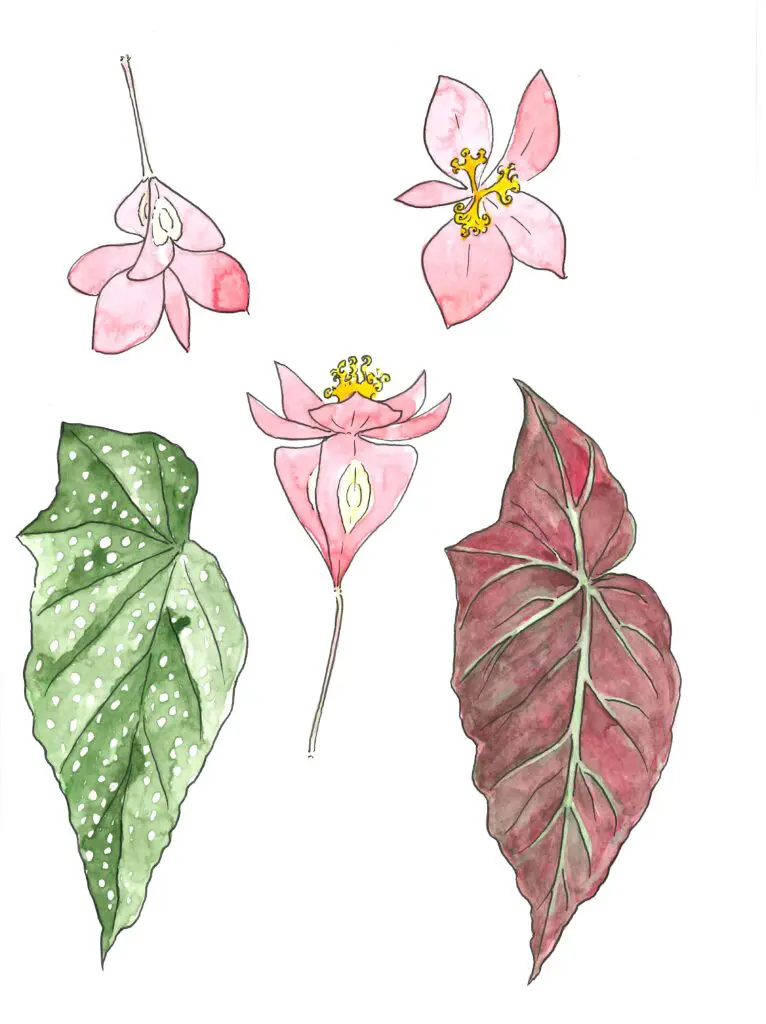
The only garden that I can cultivate here is indoors, on the windowsill over the kitchen sink: two very special plants. The first was a gift from two dear friends that I call my ‘other parents’—I tend to collect parental figures; I enjoy the feeling of being looked after no matter where I find myself—Georg and Ann, who live near Rochester, NY. Many years ago, decades? They travelled to the Freud Museum in London, where they acquired a cutting from one of Freud’s original houseplants, a begonia. They brought the cutting home, where it grew roots in a pot of its own. They continued the process of making cuttings, rooting the cuttings, and giving these cuttings away to friends. I brought my Freud’s begonia with me on a road trip to Ohio when I first began teaching at Kenyon, where it flourished on the front stoop of my faculty apartment. It sprouted a dozen elongated, asymmetrical leaves that shimmer with a technicolor translucence: a blush of red beneath a deep green, with a constellation of silver spots. A robust inflorescence of shiny pink flowers dangles from the ‘head’ of the plant. The sex of each flower is rather cryptic to me—begonias are monoecious, meaning that one plant produces separate pistillate and staminate flowers, yet the pistils and stamens in begonias have evolved to visually mimic each other, to trick pollinators into visiting both types for the potential reward of pollen. To me—the little golden bundles of pistils look like twisted fusilli pasta, with an extra curl on the tips, while the staminate flowers look like little ladyfinger pastries. Perhaps I’m writing these metaphors while hungry.
I sought out this new knowledge to explain the mystery of why the begonia seemed to be producing two very different styles of flower shapes which each revealed similar-looking pistils and stamens. I learned that begonias are sequentially bisexual. (In botany, this is sometimes called sequential hermaphroditism, or in this case protandry, which roughly translates to ‘first men.’ I prefer my loose mistranslation of bisexuality, yet even that is a false comparison to human sexuality). The staminate flowers open first: each flower opens its sparkling heart-shaped tepals and petals like a bivalve clam or a coin purse to reveal a bundle of golden spirals. After the staminate flowers bloom and fall, the pistillate flowers develop: each of these flowers has two zones: the inferior ovary rests within a little semi-translucent pocket flanked by pink ‘wings’ with a gentle torque, and the petals and sepals—three or four per flower—circle the curlicue pistils.
The other plant is less glamorous but offers an equally rich backstory. The pawpaw is Ohio’s state fruit, and the tree is native to this region. The pawpaw is a megafruit, theorized to have co-evolved with the megafauna of now extinct giant sloths. The fruits are oval, green maturing to black, containing a white, mucilaginous, fibrous, creamy fruits evocative of banana, mango, and strawberry. It’s an acquired taste and texture, and when I recently brought my visiting mother to a pawpaw grove and handed her a fruit to sample, she spit it out and said, “not for me.” The flesh of each fruit holds half a dozen slippery seeds the size of a wooden token or small cookie. I gathered a handful of these seeds last autumn, dried them off and kept them in my fridge so that I could plant them this spring. Sadly, all of the seeds developed a secondary mold, save one, which I planted in a little green pot. I lost hope for the seed after several months of no sign of life, yet I left the pot out on the stoop all summer, and when I returned from my travels, lo and behold, a little pawpaw sapling had sprouted up through the soil. I will plant the pawpaw tree outside next year, if she survives this winter in my windowsill. I have kept many more involved gardens in the past, which I’ll be happy to tell you about.
Perhaps this intimate care for nonhuman species is a type of queerness? Can queerness be defined as deep, intimate care for ‘the other’, when that ‘other’ is someone or something different than what is prescribed and expected, something other than a human being of the opposite gender, in a monogamous marriage? Maybe here in Ohio I have two partners: my begonia and my pawpaw. I see them every day, I water them when they crave it, and they keep me aesthetically entertained and help me breathe. There’s no practical use for these plants, no reproductive quality to this relationship; neither is there any practicality or reproductive result to any of my sexual or romantic human partnerships. It’s more like the sensation of limerence—I deeply admire these plants, I’m thrilled by their beauty, I am eager to care for them. The deep, mutually beneficial, likely even symbiotic relationship between a houseplant and a human, or a gardener and her garden? It’s neither sexual, but it could certainly be romantic, and I do feel that many writers throughout history have waxed poetic about their plants, including Kincaid, whom you mentioned, and Vita Sackville-West, a lesbian gardener if there ever was one.
Frances
Dear Frances,
How are you? Where are you now?
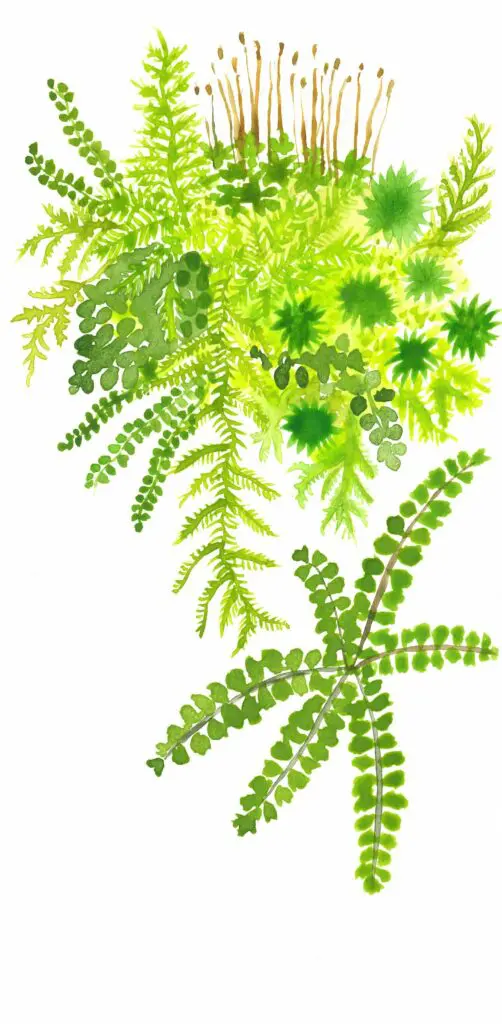
In the seventies my parents studied macrobiotics, and the first ten years of my life I was raised on a very strict diet of brown rice, vegetables, beans and seaweed. We were poor, old sourdough bread was steamed until it was soft again, fish was for special occasions. In summer the whole family and half a household would be loaded into a small red R4 Renault car and we’d drive to a summer vacation of lectures and workshops in a community for macrobiotic education. A farmhouse in the woods served as a temporary communal study center, people with histories of illnesses in their families would gather and meet over cups of miso soup and substitute coffee. The park and forest were cool in summer, under the rhododendron and pine trees grew cushions of moss, the hollow under heavy branches and dark green leaves made an ideal house. I could lay there for hours, playing on the moss, gathering pinecones and sweeping the soft forest floor with dried pine needles. Nutritional deficiencies made me a quiet child, drawing and reading were my specialty and I loved to sleep during the day. The mosses on a sandy soil between the roots of the pine trees made for excellent summer naps. Years later I was given a handful of sphagnum moss by a friend who recreates biotopes in his garden. In a bucket I made a tiny bog; sphagnum floated at the top and rainwater entered from below. Twice a week I’d water the mosses, watching them grow in a sunny spot in the garden. The memories of mosses (not sphagnum but the more common feathermosses and the little umbrella mosses) flooded back. These little plants made sense to me. I’m not like a flower, I don’t want to bloom in any gender, I don’t want to make fruit, there is no harvest here. The metaphors for girls, women, artists, students, successful practices and nuclear families don’t reflect here, in the shade of the rhododendron. This dappled shade is for mosses and similar beings, we are happy to support each other, we rest, collect dew, shelter little critters, support new plants, share rainwater, grow spores, and have been doing so for millions of years. I can recognize myself in the mosses, they are on their own and they are together, just like me, I’m always working together with others, critters, fungi, artists, students, gardeners, plants, friends, and I am always on my own, in the periphery, going my own way.
Sometimes I draw mosses the size of a person, with oil paint on fabrics of wool and cotton. Sometimes I draw portraits of people who remind me of mosses, like Emily Dickinson who writes about violets. The Sphagnum mosses remind me of the Medusa, a head full of snakes. The mosses live together like sisters, side by side, becoming soft green cushions in a forest.
In Nagano is Koke no Mori, a moss forest high up on a mountain where it is always cold. We walked on wooden planks into this forest, wondering at boulders and tree stumps covered in moss. Often people talk about their roots; in these mosses I recognize a different metaphor. Moss doesn’t have roots, and they’re not growing tall with long branches. Mosses are small, soft, reflecting bright green light. After a storm, when you walk along the road, you’ll find bits and pieces of moss blown by the wind from gutters, roof tiles, and old trees. These pieces of moss will land somewhere and start anew. If the conditions allow, they’ll make a nice new cushion and hold each other warm. This is a very old story, these mosses evolved long before flowering plants appeared, and still this way of life is working well. A long time ago I decided it was healthier to take a distance from my family, we’re no longer in contact. I was born in a city, but I grew up in the countryside. I went to school in different places, and when I tried to leave everything behind, I again moved to another city. Every time I had to restart, make new friends, build up a new cushion. I don’t feel roots, I feel a freedom to travel, and while it isn’t easy, I did find a community of queer people and peer support.
I like to look at the Amazonian women on Greek pottery, riding horses, wearing colourful knitted leggings and cool hats. I try to imagine what life was like, it is quite possible gender was less binary. The bearded Medusa smiles from the old Greek roof tiles, she wards off evil. She seems happy. She’s supposed to look ugly, but she doesn’t seem to care. Big fangs protrude from her mouth. She doesn’t wear flowers, she’s not a matrimonial figure. Her children are the corals and Pegasus, a horse with wings, born from her blood when she was murdered. It’s strange she was murdered, because her name is Greek for protectress or guardian. Who is she protecting? Possibly the Greek myth of Medusa is a newer story written over a much older one, because it does not make sense from her perspective. Here she is, in her garden, with her sisters, all minding their own business, not asking anyone to enter. Why did the men had the irresistible urge to enter her garden and be turned into stone? This very old story has fragments painted on a funerary amphora found in Eleusis, Greece. Around 600 BCE a young boy’s ashes were buried within this beautifully decorated urn. The drawing shows Medusa and her sisters (all with snakes in their hair) lived in a peaceful garden with birds and wild plants. The jar has two styles of drawings, a combination of a very skilled artist’s work for the animals and people, and expressive children’s drawings for the monsters’ heads. Possibly the siblings of the boy were painting their favourite story, and the drawings are remnants of how children and grief had a place in this culture. This is all my own speculative fabulation, not much more than a hunch based on my own interpretation of drawings. The small mosses are my sisters in the garden, both of us with unruly hair. Like Medusa, we’re happy companions protecting slugs and beetles.
Eline
Dear Eline,
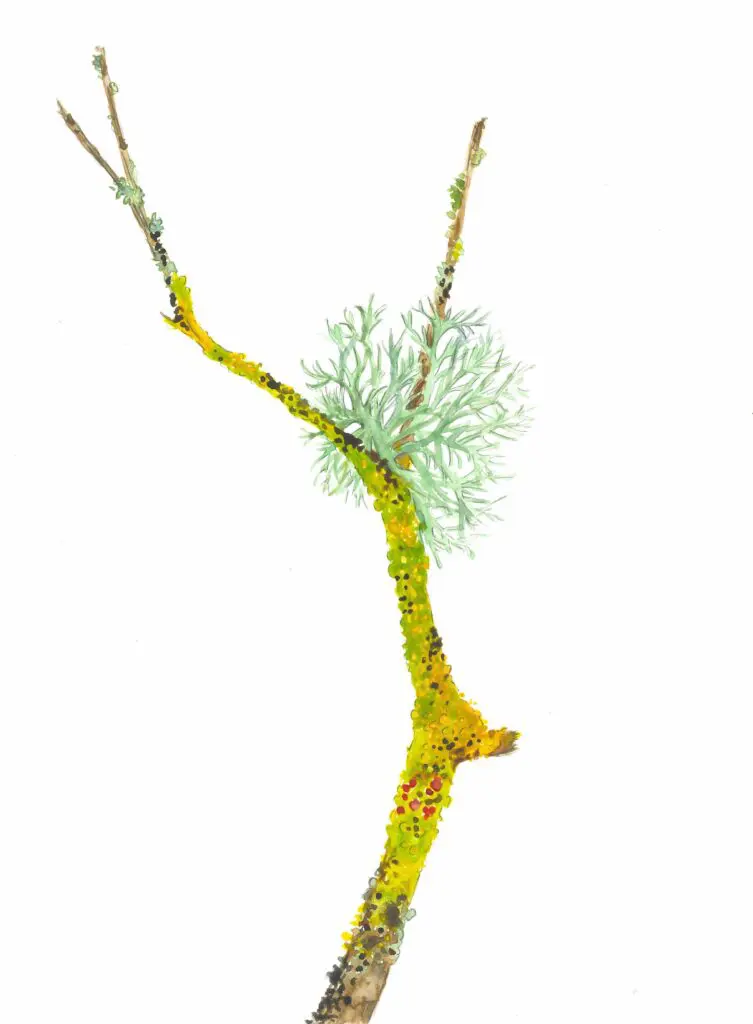
I am delighted with your nostalgic, queer reading of moss-as-other—I share a similar affinity for bryophytes, liverworts, slime molds, lichens, algae, ferns—the beings that are often bundled under the umbrella term ‘cryptogams,’ named by Linnaeus for their ‘clandestine marriage’ or hard-to-find gametes, (not to be confused with ‘cryptograms,’ defined by the Oxford dictionary as either a text written in code, or a symbol or figure with secret or occult significance). The term has historically been applied to ferns and fern-allies—plants and plant-like forms that are difficult to categorize; they are nature’s puzzles. I love that concept of a fern ally—I am a lichen ally, or perhaps a lichen lover. Recently, I have fallen for an odd genus of cyanobacteria that I discovered on the side of the road in both Edinburgh and Gambier, Ohio: Nostoc. I have now learned, through obsessive research, that the species I found in these two suburban, somewhat trashy sidewalk habitats, is Nostoc commune, bearing such splendid colloquial names as star jelly, spit of the moon, troll’s butter, fallen star, and witch’s jelly. The colonies that I observed line the edge of the pavement in clusters of juicy, squishy, dark green blobs. At first glance, they look quite similar to algae you might find in a rock pool on an ocean beach, but the forms are more snot-like, and they can thrive in both aquatic and terrestrial spaces. In my research, I found a much more charismatic species of Nostoc to be Nostoc sphaericum, which develops semi-translucent, shiny, blue-green orbs, ranging from the size of marbles to quinces, although I haven’t yet observed it in the wild. Sexual reproduction in nostoc is absent—they reproduce asexually through fragmentation and other methods that are beyond my comprehension. They are queer in all senses of the word: they’re odd, lesser known (at least by mainstream science research and in popular culture), literally marginalized in that they grow in the margins (sidewalks, puddles), asexual, and difficult to categorize. They’re winning at life: they’re unbothered, fluid, adaptable, and thriving globally.
An update on my partners, begonia and pawpaw. The begonia flowers blossomed and fell, seemingly in good health. The pawpaw sadly seems to be either ill or dead, although perhaps in my ignorance the plant is just in a dormant phase for the winter. You are correct in your recent letters that not all plants should be held captive as houseplants, certainly not a young tree like a pawpaw sapling; I feel guilty, and so today I will transplant the sapling to the backyard. It’s an alarmingly warm October day, so perhaps we are all just confused—the pawpaw, myself—about how to dress, whether or not to keep our leaves on, and when it’s best to rest and sleep.
I feel that it is important to acknowledge that my love of gardens and literature, and for these particular authors, can be traced back to my grandmother Helen. In addition to Kincaid and Sackville-West (Helen was more of a Virginia Woolf fan, but through association, she added Vita to her repertoire), I’ll add my grandmother’s other favorite, Colette, who wrote about her gardens in Flowers and Fruit. Helen kept an abundant garden. She had a circle of herbs to clip into her salads: parsley, savory, marjoram, basil, tarragon, dill. She and my grandpa Larry tended several fruit trees in their backyard: plums, apricots, and perhaps a few apple trees, although the apricots stand out in my memory. Helen also kept several raised beds for vegetables and flowers: lettuces, carrots, even horseradish with gnarled, sprawling roots which she wrestled from the ground. She preserved whole flowers upside-down in sand and salt, and others she pressed into books and cards. She made vinegars with her herbs. She brewed violet syrup with flowers from the yard. She and Larry even tried their hands at the art of bonsai—I remember a pygmy pomegranate tree that produced tiny fruits, and a little lap-sized, twisted hazelnut, or chestnut—it’s been too many years for me to remember, and sadly Helen is no longer around to deny or confirm these narrative details. Her passion for gardening and cooking rubbed off on me, and in my adulthood, I have attempted to keep several gardens in several of my temporary residences. It’s obviously tricky to keep a garden as an itinerant academic. Fortunately, my sister Liza seems to have grown into a master gardener: she built herself a chicken house, several beds of overflowing vegetables and flowers, and a row of raspberries and blueberries. I’m still fond of the garden that I began in Vermont before moving to Ohio for this teaching job: the previous resident of the house had planted dahlias and gave me instructions for digging up the bulbs to keep safe and dry in the cellar over the winter. I had previously found dahlias too feminine and showy for my taste, but after growing the flowers for a few years, I realized that they are deliciously fragrant, and that their tubers are edible raw or cooked; they’re eaten often in parts of Mexico, where the species is native to. Perhaps one day soon I’ll find the stability in my life and career to grow dahlias again, and all of the other plants that delight me (countless.)
Thank you for sharing all of your fragments—I personally relish the fragment form, and the nature of our correspondence,
Frances
Dear Frances,
Three times now we saw a bird of prey in the garden being chased out under loud arguments and feathery attacks by the magpies and the crows. The big birds are a good sign, it means we have a lot of small birds too. We’re waiting for the robins to arrive.
The weekly gardening sessions I organize at the academy are an exercise in creating open safer spaces. Here students are becoming gardeners by simple, relaxing and almost mindless garden-tasks like raking leaves to make a leafmould and carefully cutting (with scissors) the grass between the wild plants growing in the lawn. Naturally, I explain why we’re doing these things, how the ecology connects between species and the environment, but the subtler details of how we would label ourselves are left out and it is for every student a personal discovery how they tie into the string figure of the garden. When we talk of plants we use the pronouns they and them; it makes more sense because of how plants really are escaping binarism. I often wonder who came up with this idea of normalcy, it simply doesn’t make sense. Dissolving the edges of a definition and bringing language back to a playful game of signifying creates a different kind of safe space, a place where we can forget about ourselves for a moment and feel connected to nature by curiosity. At the end of the session, after seeing the garden from up close, I look up from the grasses and see the mosquitos dance in a cloud, the acer leaves catch the golden evening light. This is a feeling of belonging to a wonderful place, a place that is perhaps not entirely safe (with poisonous plants and hunters and prey) yet with a lot of freedom to be who we are and how we feel.
Eline
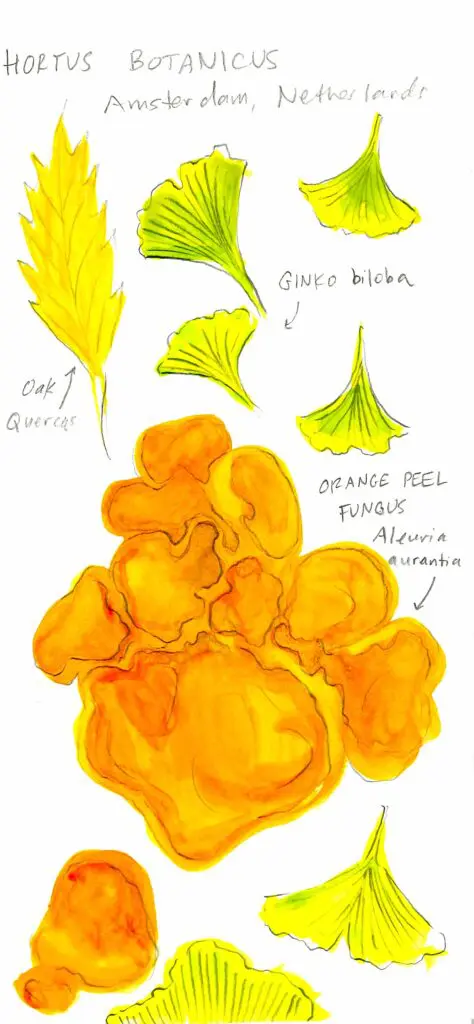
Dear Eline,
It has turned cold enough here that my little dog refused to get out of bed in the morning. She finally perked her head up when I spooked a herd of deer away from the window by grinding my coffee. The vibrant red and orange hues of the maple trees have begun to shift into ochres and umbers. There is a tree that I believe is native to Ohio, sweetgum, Liquidambar styraciflua, whose leaves resemble those of a large-lobed Japanese maple, and so far this tree wins for brilliancy in color—one single tree simultaneously displays a range from canary yellow, through the warm palette to a red-purple so dark it resembles dried blood. The autumn mushrooms are cropping up and quickly rotting; I was particularly thrilled to find Lion’s mane, or Hericium erinaceus. The roadside Nostoc has shrivelled and dried up and now resembles dried mud.
I’ve been thinking about gardens, and how whenever I travel to a city, the first place I seek out is the botanical garden. I hope to visit the gardens in Gothenburg, Amsterdam, and Antwerp on my upcoming travels.
I look forward to meeting you soon, and viewing the lesbian garden in person,
Frances


