
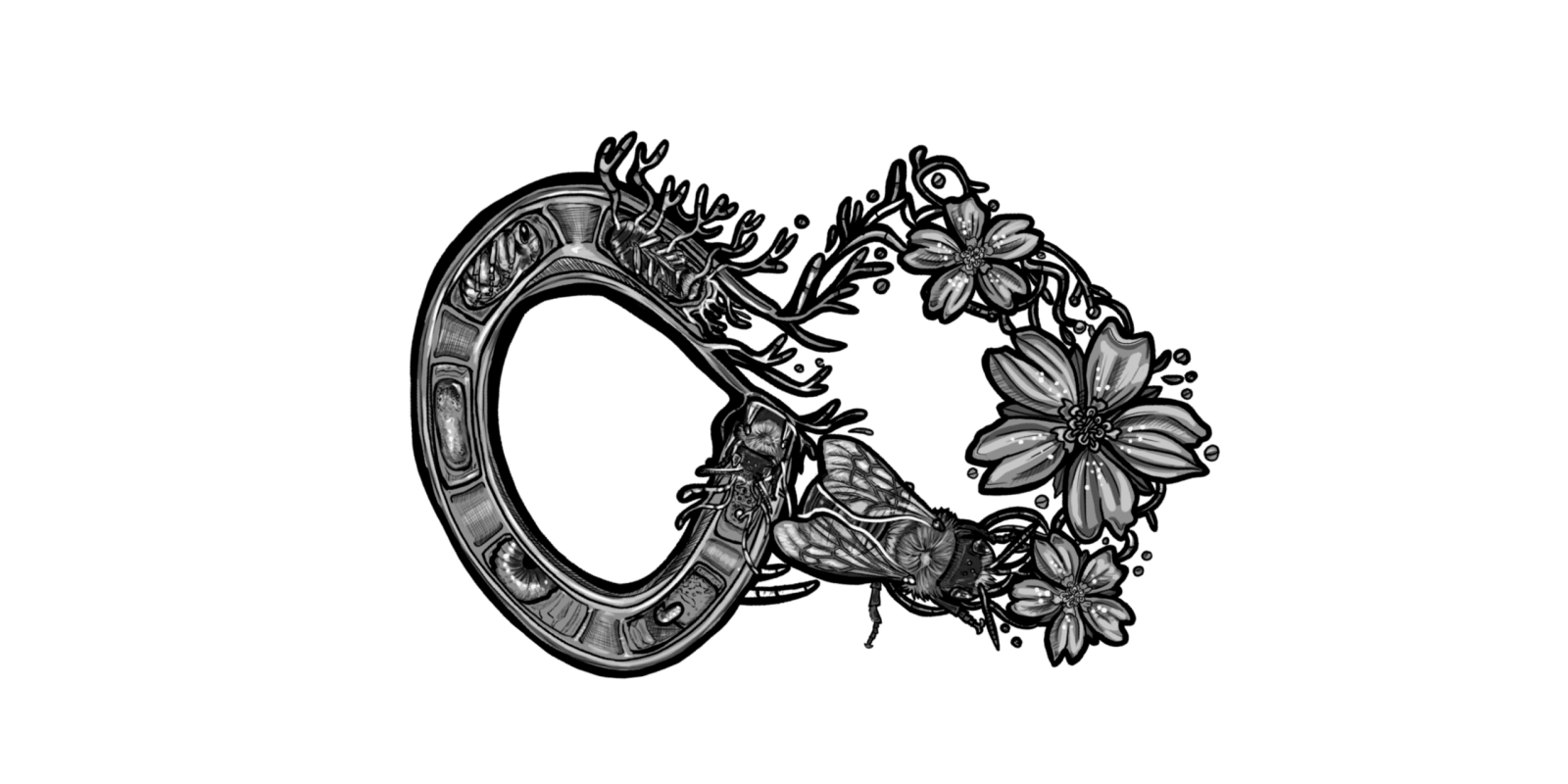
Saccharine slime, yellow, gooey flower grime: A pollen ball—not exactly a flower’s ideal fate. But flowers are islands and bees their boats, loading their bodies with only what they need to stay afloat in the droning on and on of petals and pollen and pupa, rolling them together and again and again…
One loses track
of when flower becomes bee after such a frenzied spring. Precious pollen, like time levied on tibial spurs branched and curled to hold on tight. Peering through bleary eyes, past smudges of yellow haze, a mother bee surveys where to place the final egg—the whole point of this sisyphean pollination game. Don’t tell the flowers.
But, reproduction is never twofold and clean, she always spreads more than just her genes. She would never forget me. Misunderstood by many as a floral stowaway, my spores melt into the maternal ambrosia of nectar and pollen. Puckered by a pollen ball, we are set to rock cradled above a stream of summer traffic: Earwigs and spiders being born and consumed, disinterested in us brood.
It’s never fun to hurt your host after growing so close, but how many skins must a bee try on before it comes into its own? I graciously wait five molts to toll before embalming my bee into mummy. It’s still itself, just a little less mushy.
Small and cylindrical with a fair hull, a once larval figure becomes a shipyard for my spores. Seeded vessels set adrift one by one by one, they bubble up and part a flat opalescent sea, the body of the bee…
One loses track
of when bee becomes me. But bees are islands and Ascosphaera their boats loading their bodies with only what they need to stay afloat.
Biological Context: Ascosphaera torchioi is a fungal pathogen of a solitary bee named Osmia. The bee picks it up from flowers as it forages for what’s called a “pollen ball” (pollen collected from multiple flowers mixed with nectar). For solitary bees, the female builds up pollen balls, stores it in some type of crack/crevice, and lays an egg on them. As the egg develops into a larva (or immature caterpillar-like form) they feed on the pollen and ingest the fungal spores. Then after 5 molts, when the larva is almost an adult, the fungus takes over the body and consumes the bee from the inside out. In the end the larva looks like a mummified version of itself full of spores.


