![Edinburgh journal of natural history and of the physical sciences.
Edinburgh [etc.] :Published for the proprietor [etc.],1835-1840.
https://biodiversitylibrary.org/page/33665579](https://queerflora.org/wp-content/uploads/elementor/thumbs/zebra_Edinburgh-journal-of-natural-history-and-of-the-physical-sciences.-copy-e1771594905827-rjfo6upbiobnoojtvxp1bo3bf9x6s7sadu2etzwm68.jpg "zebra_Edinburgh journal of natural history and of the physical sciences. copy")
Over the past decade and a half of working in science communication, I’ve come to realise a fundamental truth: science is a lie.
Perhaps I’m being a little melodramatic here, and certainly provocative. It would maybe be fairer to say that science is a fiction. And not to forget that there’s a myriad of ways that we can define science. This is in no way an indictment against the scientists that have gathered a veritable mountain of empirical data over the course of history.
More specifically, I’m referring to the sciences of taxonomy in zoology, botany and mycology. It’s a grand undertaking to try and categorise all living organisms. But it’s worth remembering the artificial nature of this work, to recognise how our own biases can affect it. Our worldview, our binary approaches to ideas of sex and gender, can limit how we explore and categorise the natural world.
We love order, as a species. We’re keen to look for patterns, even where there are none. It’s a skill that humanity excels at over all other species, and one of the reasons we’ve become king of the proverbial jungle over the last few million years. Pattern recognition has helped us spot the signs of a sabretooth tiger, work out the best place to plant crops and build a home that can survive a harsh winter. Patterns are good, it would seem.
But then we’re presented with the chaotic glory of the natural world. Millions of years of random mutation and evolution have resulted in an almost impossible number of lifeforms, filling every feasible environmental niche and convergently evolving into similar bodies oceans apart. It’s a roiling, raging cauldron of DNA, adaptation, and transformation that never sits still.
Naturally, the human instinct is to cram this diversity into neat little boxes. In the eighteenth century, Carl Linnaeus led this organisational charge when he spearheaded the concept of binomial nomenclature. Each individual species received two names: a genus (or generic) name, and a species (or specific) name. To cite an example I know you’ll recognise, we are all Homo sapiens. The genus Homo also contains some of our distant ancestors, like Homo neanderthalensis or Homo habilis. Similar to us, but not similar enough to be the same species.
And it scales up from there. A genus forms part of a family, which forms part of an order. Get yourself a collection of orders, and you’ve got a class. A bunch of classes forms a phylum, which collectively form a kingdom. Boxes in boxes in boxes, neatly ordered and understood. Somewhat counterintuitively, this scientific endeavour is oddly mystical, a modern law of names. If we know a being’s true name, or rather label it with one of our choosing, we have understanding of it, and power over it.
Linnaeus made a valiant attempt. In his first go at using the binomial naming system in his Species Plantarum in 1753, he named just under 6,000 plant species. He thought he was roughly halfway to labelling all the plants in the world. Today, we’ve identified over 350,000 species of plant and we’re still not done.
We might love order, but nature has other plans. Relationships between different species are tough to pin down. When Linnaeus named species, he had no concept of DNA: relationships were established based on shared physical features of the plants, rather than insights into their genetic similarities. Sometimes this worked, others not so much.
Take the tale of Pepinia, a group of rather nice bromeliads native to South America. First named to science in 1870, they were labelled their own genus. Then in 1881, it was decided that they were in fact part of the genus Pitcairnia. Cut to 1988, someone took a good look at the seeds and said that they were in fact different enough to warrant recognition in their own genus once more. Only eleven years later, they were returned to a subgenus within Pitcairnia, a decision later confirmed by looking at their genome.
Largely unconcerned with their rapidly changing nomenclature, the bromeliads stuck to growing vibrant red flowers while hanging off trees.
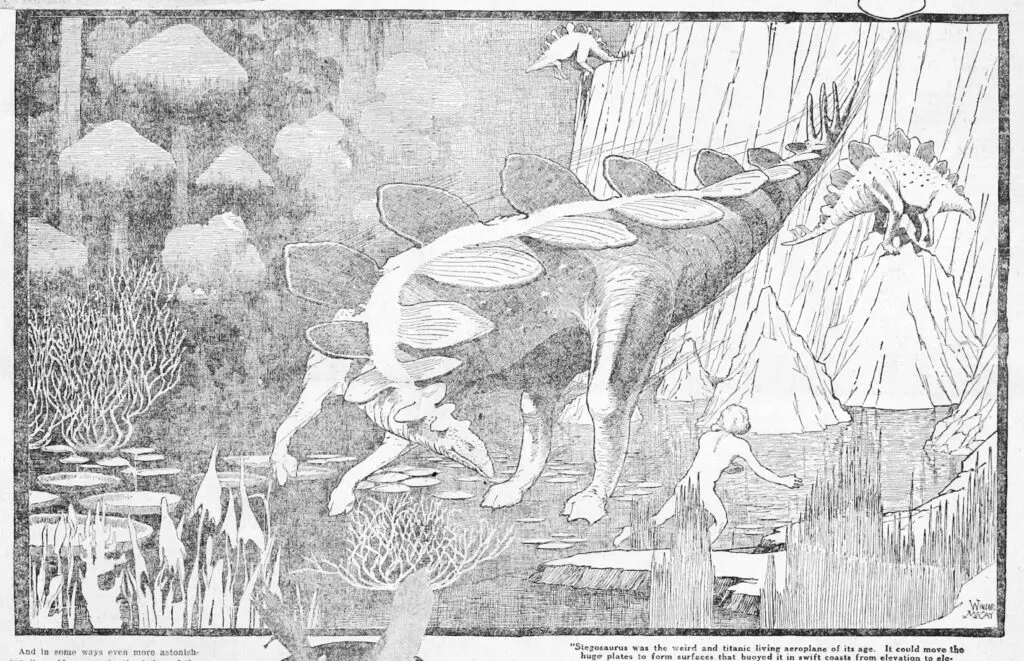
And then there are the names that get aged out as our understanding changes and grows. Homo erectus, meaning ‘upright man’, was so called because at the time it was thought to be one of the first apes to walk bipedally. We now know that some ape species were walking around on two feet nearly six million years prior to this. Or the beloved Stegosaurus, a name which means ‘roofed lizard’. It seems a bizarre moniker, until you learn that early reconstructions of stegosaur fossils placed the iconic plates flat on the dino’s back, like roof tiles.
To cite another example, we can turn to the most famous dinosaur of them all, the almighty Tyrannosaurus rex. When it was first named to science in 1905 by palaeontologist Henry Fairfield Osborn, it was published in the same paper alongside a similarly monstrous carnivorous theropod, Dynamosaurus imperiosus, which roughly translates as ‘Imperial Powerful Lizard’. In 1906, Osborn realised that the two species were in fact one and the same. Despite the Dynamosaurus specimen being discovered two years before the T. rex specimen, the familiar name won out because it was published first in the paper. There’s only one page separating us from a world where the D. imperiosus is the star of the Jurassic Park films.
The coda to this tale is that in fact, neither of these names are the first applied to what we now know as the T. rex. In 1892, veteran of the Bone Wars Edward Drinker Cope discovered a pair of vertebrae, which he named as belonging to Manospondylus gigas. Over a century later in 2000, these vertebrae were recognised as one of the first T. rex fossils found. So why are we not talking about M. gigas as king of the dinosaurs today? By coincidence, the International Code of Zoological Nomenclature who govern the rules on this sort of thing decided at the beginning of the year that if a name had been considered invalid for over fifty years, it couldn’t take precedence.
Names such as these are locked in through the weight of history, and it would take an upheaval of the classification of the species to tweak them. Not to say this is impossible though. Today, there is a gradual effort within the scientific community to address at least one element of the naming process: reducing eponyms, or species named in honour of people. There are a number of species that bear scientific or common names mirroring real world people heavily involved in colonialism, slavery and worse.
One of my favourite plants Rafflesia is named in honour of Stamford Raffles, a man whose legacy in Singapore could very generously be described as “complex”. For an employee of the East India Company, Raffles was remarkably progressive, allowing free practice of all religions along with supporting scientific collection of local plants and animals. Conversely, his planning for Singapore prioritised land for Europeans, and despite his moves to limit slavery across Asia, he still overwhelmingly benefited from it.

In 2023, the American Ornithological Society began the move to remove honorific monikers from common names of several species. In the same year, proposals rose to do similar for scientific names, but the 2024 International Botanical Congress saw voters erring on the side of individual responsibility. Whether or not this is the best decision remains to be seen; overhauling the entirety of taxonomy would be an enormous undertaking, yet continuing to celebrate toxic histories does nothing to make science, and society at large, more inclusive.
I’m not necessarily suggesting scientific names are intrinsically bad because they can potentially be inaccurate and immutable. If we all agree what a Stegosaurus is, then arguably the name is fulfilling its function as a label. But all of this is to say that the classification and nomenclature of our amazing natural world is very much an unnatural creation.
I first came to this ‘realisation’ about four years into my science communication career, which bizarrely lined up with some personal realisations. For a very long time, I’d considered myself to be Not straight, while never giving any particular thought to what I was. But then I started to reject the question all together. Why did I need to pick a lane? I like who I like. You can’t define me with a label, I’m my own person.
Like a lot of people found in the middle of the Kinsey Scale, I struggled with not feeling like I was bisexual “enough”. What does “enough” even look like? Do I deserve the label? In addition, I was in a straight passing relationship at the time: was labelling myself as bi fair? And then the question of whether I was bi or pan; how did I know which was the objectively true label about my sexuality?
Much like scientific labels, queer identities have evolved throughout history. The queer community has reclaimed so much of its language from slurs and other weaponised language. So much of our language is comparatively young, a factor that makes identifying queer peoples throughout history fraught with accusations of projection. Yes, I suppose we can never truly know if Sappho of Lesbos would have called herself a Lesbian, apart from in the purely demonymic sense.
And what does queer mean, really? For a word that mostly just meant odd for 400 years old, the last century has seen its use rapidly transform. Initially, it was used for anything outside the expected heteronormativity, before words like gay or lesbian allowed more granular understanding of sexuality. Today, it’s used in a variety of ways, but is it even the best term to use? For many, it’s a term too tainted in painful history that can’t be reclaimed. Is using the term helping or hindering? Trying to unpick this left me frustrated, and I ended up leaving the whole thing alone.
So that’s the line I took for several years. I like who I like. Names aren’t real. Science is fiction.
Here’s the catch though. Science is fiction, but it’s an incredibly useful fiction.
I couldn’t exactly tell you at what moment this finally twigged for me. It was most likely a gradual build-up over time as I was surrounded by the people who were actually naming these species. Over my science communication career, I’ve been incredibly lucky to work alongside world-class botanists, zoologists and palaeontologists. As I helped share the work they did with a non-scientific public, I realised that they’d never been cataloguing the living world purely in pursuit of objective truth; it was a celebration. They passionately loved what they work on, and the act of naming, no matter how imperfect, was how they shared and celebrated it with the world.
Additionally, names serve a logistical purpose. With the almost incomprehensible number of species in the world, there needs to be some way of parsing it all, especially today when scientists from all over the globe collaborate and share knowledge. The binominal naming system provides everyone—regardless of the language they speak—with a fixed name to reference (admittedly by forcing a Western language name on them but tackling that is perhaps a little out of the scope of this essay).
Names are also critical in protecting species from extinction. For a species to be listed on the IUCN Red List, which assesses the vulnerability of plants and animals, it first must be named. With names and assessments in place, they can be used to help influence policy and create real change that protect endangered species.
For evidence, look to the zebras. The plains zebra (Equus quagga) has a population of around half a million, but the mountain zebra (Equus zebra) and Grévy’s zebra (Equus grevyi) exist in populations of less than 3,000 each. To the untrained eye, these three species are almost identical black and white striped horses. But named to science and categorized, we know what needs protecting. Both the mountain and Grévy’s zebra are listed on CITES, the Convention on International Trade in Endangered Species of Wild Fauna and Flora, preventing and regulating their trade.

You might think this all to be a little obvious, and that I’m getting bogged down in semantics. “Of course scientific names aren’t objectively true, they’re just the labels we use!” But it’s the power of these labels that matters.
In botany, we’ve historically labelled the flowers of angiosperms as being male or female, based on whether they produce pollen or ovules. But some do both. This is, somewhat confusingly to modern ears, a quality referred to as ‘bisexual’. Some plants grow male or female flowers depending on the temperature around them. Avocados open their flowers as male one day, then female the next. Apomixis, a process that does away with traditional sexual reproduction and just produces a seed asexually, has been observed in hundreds of species including garlic and dandelions.
And then we have fungi. They don’t have sexes in any recognisable way, partially because they can switch between sexual and asexual reproduction as and when it’s beneficial. When they do reproduce sexually, they have something called mating types, which can number in the thousands. It’s only the sheer force of numbers that have prevented us from trying to cram fungi into a binary.
This is why it’s vital to argue semantics when it comes to naming the natural world. We need to be aware of our biases and think about what we might be projecting onto species that don’t really fit into our established boxes. We need a system to help us make sense of the natural world, and lets us share it with others, but it can’t be a system that forces the natural world to conform to our current understanding.
In a 2018 TED talk about the sex-changing Quindío wax palm, ecologist Brigitte Baptiste concluded by stating that “it’s time to re-join sexual and gender identity in our visions of the environment, as there’s nothing more queer than nature.” And where better to start than the very language we use to talk about it?
As for myself? Well, honestly, I’m still working it out. Not entirely unlike Pepinia, I’ve wavered between groupings, labelling myself intermittently as bi and pan, before reaching my current status of “queer”. It’s still a work in progress.
But my journey from rejecting labels to appreciating their value is a similar one to my new-found appreciation of scientific nomenclature. It’s a celebration, not an objective judgement. Over the last ten years, I’ve seen people celebrate their identities in the face of an increasingly hostile world and it so often begins with them embracing a particular name.
The mainstream media news stories titled “why are there more trans people now?” are certainly asking the wrong question, since trans people have always existed, but do highlight how they are able to live more openly. A key part of this wider social acceptance is the word trans being reclaimed by the community, as well as better understood by the wider world. Stories like this have opened my eyes to the power of a label when it’s actively embraced.
Whether bisexual, pansexual, male, non-binary or whatever label I choose is objectively true isn’t why it matters. Much like scientific names, they’re a means to an end. It’s a way for us to embrace who we are, while sharing and celebrating it with the world.
Names and labels might not be real, but that doesn’t mean they aren’t important.