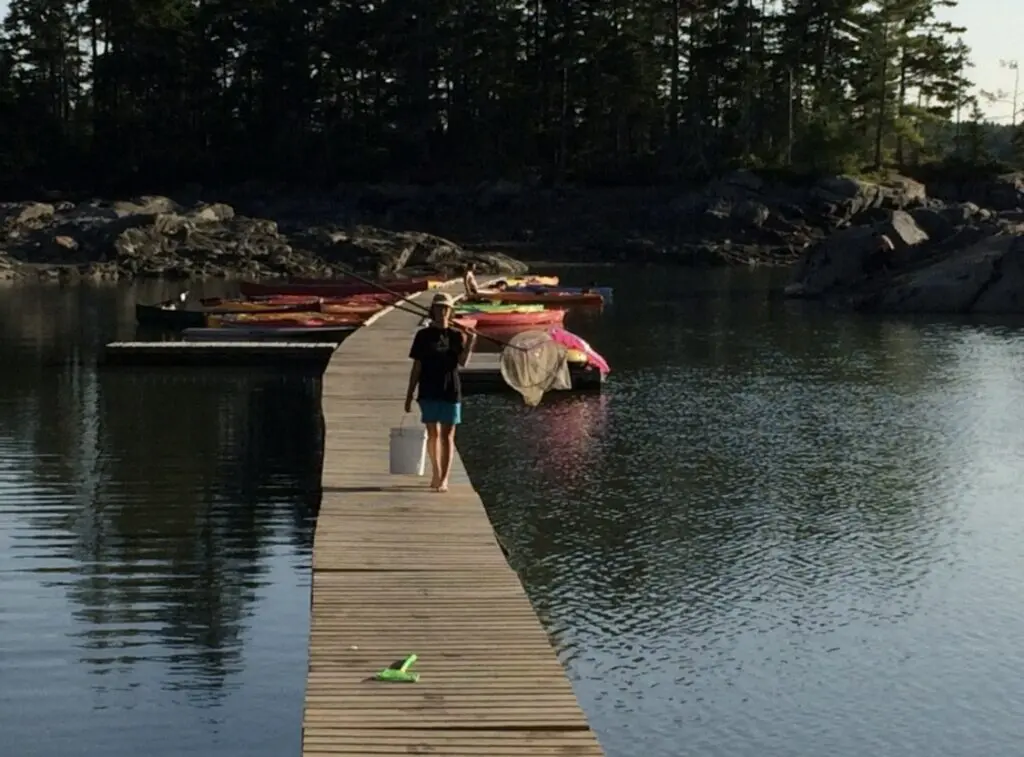
When I was in college, my father sent me a picture of my younger self standing on a floating dock in Maine. I am wearing a t-shirt and shorts that cut off just above the knee. The t-shirt hangs boxy over my frame; my chest is flat. I have the rectangular silhouette I so often wished for when scrutinizing my reflection. A long net is draped across my shoulder. It’s as tall as I am. The white fabric dyed gray from its time plunging into mudflats; sifting out shrimp and pipefish and hermit crabs. I’m swinging a five-gallon bucket at my side, padding down the salt-soaked dock on feet calloused from balancing across the jagged stretch of shore.
I never felt like I was particularly good at being a girl. It was a similar experience to entering middle school with no understanding of popular music. My favorite album at the time was Jerry Garcia’s Not for Kids Only (in fact, I did not know he had written any other music until writing these very words), so I was shocked to learn that I had a poor grasp on what other middle schoolers were listening to. Being a girl was a lot like pretending to know the songs at the school dance. I would move to the beat of the music, watch the other kids to see how they were dancing, and maybe even mouth the shape of the words. But I didn’t really know what I was doing. I never felt at ease in girlhood, but I felt perfectly natural peering into the water.
I took a lot of pride in catching eels. Each summer we’d camp in Maine, and I’d put my big net to use. I would catch crabs, stuffing crabbing nets with cheap hotdogs and rocks from the shoreline. I would send these neon parachutes down to the sea floor on string as dozens of green crabs jostled for a taste of bait. If the tide was high enough, and I was lucky, I would spot an eel: wriggling soft green-brown through the murk, sending a shower of hotdog bits from the lure.
You can’t catch an eel with your hands. You can entice it to the surface of the water if you raise your crabbing net gently enough. But if you sneak your hands around it with enough speed to grab it, it may bite you or slip between your fingers. Its soft, muculent body is not meant to be held still. I’ve tried to grab an eel many times without luck. But I had the big net. No one else on the dock had the big net. A few other kids had large enough fishing nets to fit an eel inside, but the loose weave meant that any potential catch could slip easily through the holes. My net was fine mesh, and the handle was as long as I was tall. I could sneak my big net underneath an eel while distracting it with the crab bait in my other hand. I could use the long handle as a lever to quickly scoop upward. I could keep the eel safely in water, trapped where I could see it. Not fixed into stillness, but close enough for me to feel satisfied by its proximity.
I never got the hang of girlhood. No matter how hard I tried to be pinned by it, I couldn’t manage to be captured. It took me many more years to find a home in this slipperiness. Even then, my body was an unwieldy thing that I had to wrangle; I scrutinized my reflection in car windows, peeled adhesive from my chest, itched the rash between my breasts when I had been binding for too long. Only when I returned to the water’s edge did this gnawing discomfort dissipate. Hair spooled into the murk, nose nearly touching the glassy surface, reflection winking back in warped flashes. Here, my body connected me with the world. I could enmesh myself with damp wood and sharp rocks.
My body still challenges me at times, but I’ve started making the changes I’ve been fantasizing about for so long: removing my breasts, shifting fat and muscle, sprouting stubble on my chin and cheeks. I sit more comfortably inside my flesh. It is no longer just a tool I use to grasp at the world. I still love being near the water; the feeling of melting into the landscape. But lately I’ve been able to move away from it without losing myself.